
Buying Guide · Size & Compatibility
Bed Size & Mattress Compatibility: Getting Dimensions Right Before You Order
Size mismatches are one of the most avoidable -- and most expensive -- procurement errors in the bed business. This guide explains how UK and Continental European sizes differ, why mattress size is not bed size, and what to confirm about internal dimensions, tolerances and gas-lift compatibility before you commit to a container.
- Beds + Mattresses
- UK · EU · Custom sizes
- For importers & retail buyers
Read this first
Three things to get right before anything else.
Most size-related disputes trace back to one of these three points. Resolve them at brief stage and the rest of the order process becomes straightforward.
-
Mattress size and bed size are different numbers
The mattress size names the standard the bed is built for. The overall bed size -- including rails, upholstery and headboard -- is always larger. Use the right figure for room plans, listings and loading plans.
-
UK and European "doubles" are not the same mattress
Shared size names hide different dimensions. A frame quoted for the wrong regional standard will not accept local mattresses -- and returns at container scale are not a realistic option.
-
Internal dimensions, tolerances and gas-lift ratings are confirmed per model
Catalogue figures are indicative. The values that protect you are the ones stated on the model's specification sheet and written into your order confirmation -- before production starts.
Market standards
UK vs Continental Europe: common mattress sizes.
These are the mainstream retail standards your bed frames and mattresses will be judged against. Confirm which standard applies to each destination market in your brief -- it drives frame dimensions, slat layout, packing and loading.
| Market | Common label | Mattress size (mm) | Buying note |
|---|---|---|---|
| UK | Single | 900 × 1900 | Children's, guest and entry-level size. |
| UK | Small Double | 1200 × 1900 | Space-saving double for smaller rooms. |
| UK | Double | 1350 × 1900 | The standard UK double -- high-volume size. |
| UK | King | 1500 × 2000 | Core size for online retail and storage beds. |
| UK | Super King | 1800 × 2000 | Premium tier; check room access and carton size. |
| EU | Single | 900 × 2000 | Continental single -- longer than UK single. |
| EU | Double | 1400 × 2000 | Common double in France, Germany and beyond. |
| EU | Queen | 1600 × 2000 | Mainstream upgrade size across the continent. |
| EU | King | 1800 × 2000 | Large format; confirm headboard width and access. |
All values in millimetres (width × length). Other national standards exist -- always confirm per destination market.
Same name, different mattress
A UK double mattress (1350 × 1900) and a Continental double (1400 × 2000) differ in both width and length. A frame built for one will not properly accept the other -- the mattress will swim in the frame or refuse to fit at all. Never quote a size by name alone; quote it by dimension.
Selling beyond the UK and EU?
US, Australian and other markets use their own standards, and custom sizes are possible on many models. State the destination country -- and the exact mattress dimensions your market expects -- in your inquiry so the model is quoted against the correct standard from the start.
Mattress size ≠ bed size
A 150 × 200 mattress does not mean a 150 × 200 bed.
The size label on a bed refers to the mattress it is built to accept. The product itself is always larger, because the frame has to hold that mattress:
- Side rails and upholstery add width on both sides -- especially on deeply padded, curved or winged designs.
- Headboard thickness adds length behind the mattress, and tall statement headboards add visual and physical bulk.
- Footboards and curved wings can extend the footprint further than a minimal platform design.
Indicative example
An upholstered bed built for a UK king mattress (1500 × 2000 mm) may measure roughly 1650-1850 mm wide × 2150-2250 mm long overall, depending on the design. Treat this as orientation only -- the confirmed overall dimensions for your chosen model are stated on its specification sheet.
Why it matters commercially: overall dimensions drive your customers' room-fit expectations, your showroom and warehouse planning, and -- together with carton dimensions -- your container loading plan.
Inside the frame
The internal dimensions that actually fit the mattress.
Fit is decided inside the frame, not on the label. When you review a model for your market, these are the measurements worth requesting in writing:
- Internal width and length -- the clear space the mattress sits in. A small working clearance allows for bedding and easy dressing without the mattress shifting in use.
- Platform or recess depth -- how far the mattress sits down into the frame, which affects both appearance and how securely it is held.
- Visible headboard height -- mattress thickness plus base height determines how much of the headboard remains on show. A thick hybrid on a low headboard changes the product's whole look.
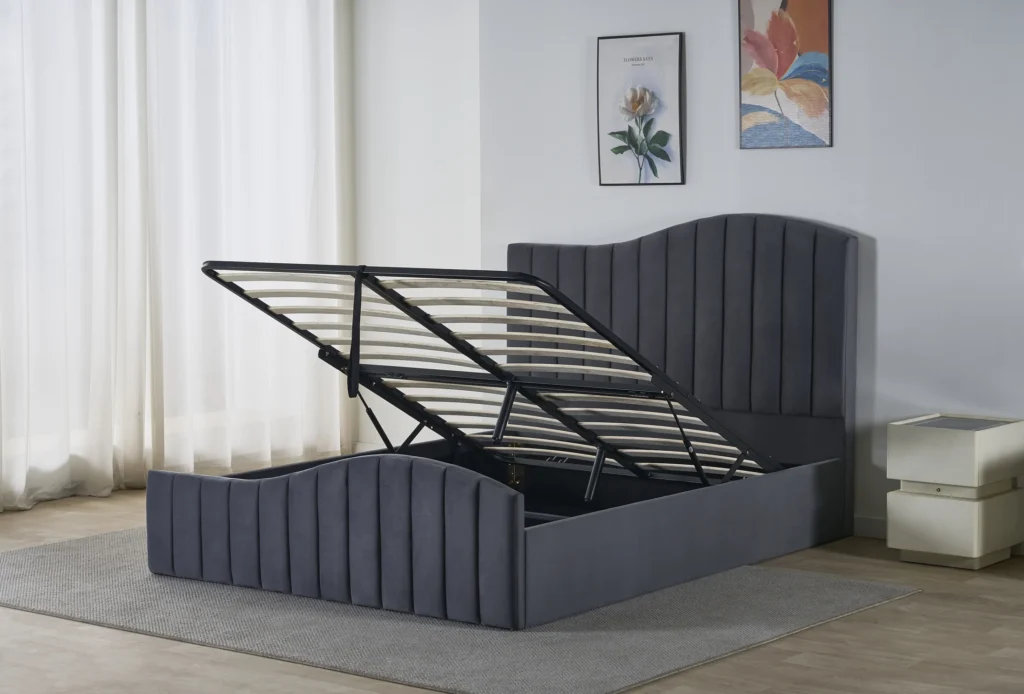
On gas-lift and ottoman storage beds, internal depth also defines the usable storage volume your customers will judge -- worth checking alongside the sleeping dimensions, not as an afterthought.
Tolerances & confirmation
How to confirm sizes so they survive production.
Upholstered and foam products carry small, normal production tolerances -- indicatively in the range of ±10-20 mm on mattresses. The binding values are the ones agreed on your confirmed specification, not catalogue figures. This five-step path keeps everyone aligned.
-
01
State the market
Name the destination country and the mattress standard your customers buy, with exact dimensions.
-
02
Request the dimension sheet
Ask for internal and overall dimensions for each model and size you plan to carry.
-
03
Check the fit both ways
Mattress against internal space; overall footprint against room, warehouse and listing requirements.
-
04
Put it in writing
Record sizes, dimensions and agreed tolerances on the PI and the Final Order Confirmation before production.
-
05
Verify on approval
Measure the approved sample against the specification, and re-check dimensions when goods arrive.
A note on samples: for new developments and complex custom projects, an approved physical sample is the strongest size reference you can hold. For configuration changes on an existing model -- a different fabric, leg or slat system -- the confirmed specification sheet usually suffices. See what to confirm before approving a sample.
Functional compatibility
Mattress weight, gas lifts and frame structure.
A mattress can fit a frame perfectly and still be wrong for it. These three checks prevent the functional complaints -- heavy lifting, dipping, warranty disputes -- that surface months after the container lands.
Gas-lift rating ↔ mattress weight
Lift mechanisms are rated for a mattress weight range. A thick, heavy hybrid or latex mattress may need a higher-rated strut; a very light foam mattress may not hold the frame closed. Confirm the mattress weight per size against the mechanism rating for your chosen model.
Slat system ↔ mattress type
Curved and straight slat systems behave differently, and slat spacing matters: many mattress warranties set a maximum gap between slats. Heavier mattresses may call for closer spacing or an alternative bed-base option on the same model.
Centre support ↔ wider sizes
At 1600 and 1800 mm widths, a centre rail with support legs is typically required to carry two sleepers and a heavy mattress over years of use. Confirm the support layout for every width in your size plan -- not just the volume size.
Buying mattresses from the same programme? Roll-packed mattress weights per size also affect handling, warehousing and last-mile delivery -- ask for packed weights together with the packing data.
Before you order
What to include in your inquiry.
- Destination market and the mattress standard (with dimensions) you sell to
- The models you are considering, and the sizes you need per model
- Mattress type and approximate weight per size, if you are pairing gas-lift storage beds
- Approximate quantity plan, so MOQ, packing volume and loading can be assessed realistically
Keep building the brief
Where the commercial numbers come from.
This page deliberately stops short of order planning. MOQ per model, size and colour; carton dimensions and packing volume (CBM); and 20GP / 40HQ loading quantities all depend on the specific model, size mix and configuration -- and are confirmed per quotation, not fixed in a guide. These resources take the next steps:
Matched to this guide
Related products and buying resources.
Explore products and supporting guides matched to the categories, features and resource topics selected in the WordPress editor.
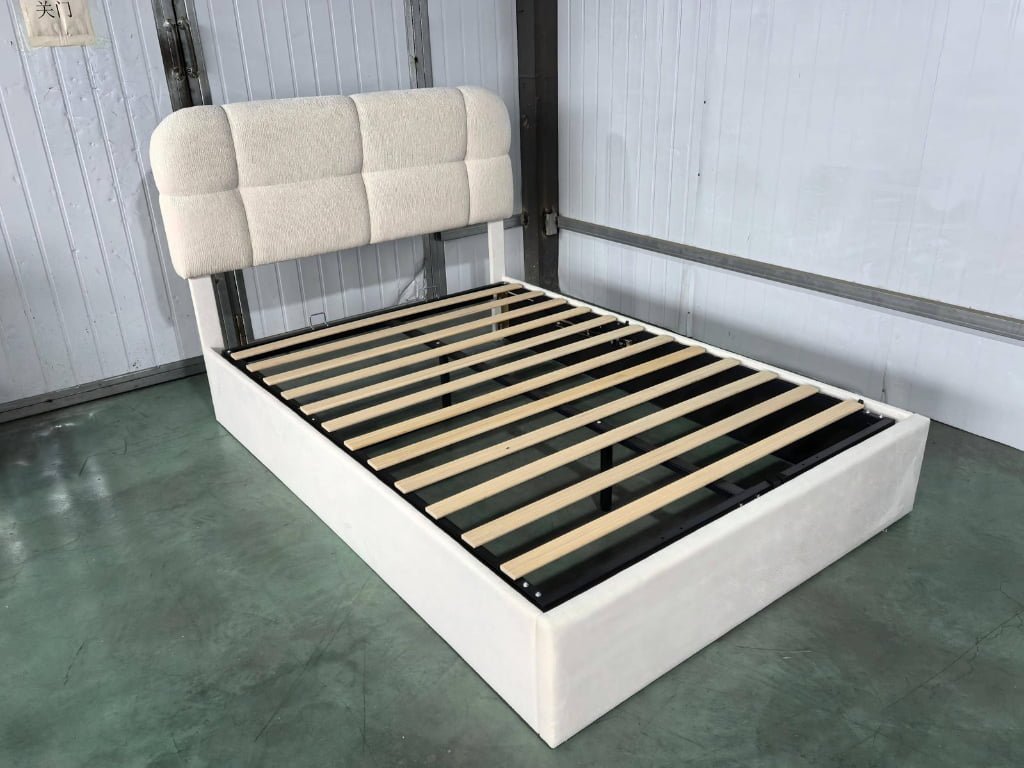
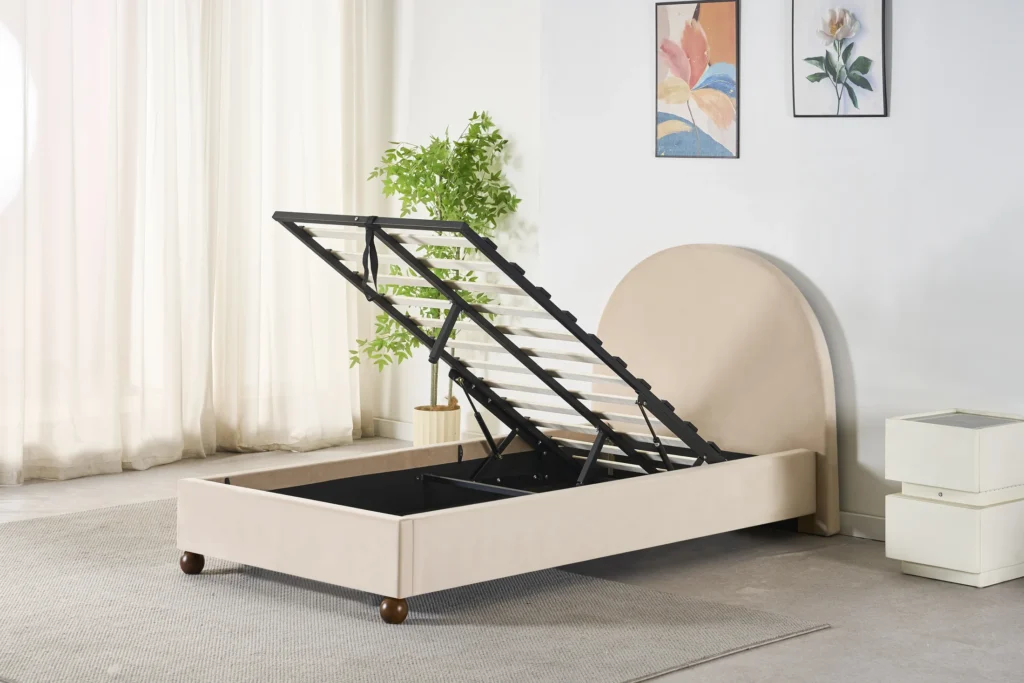
Products linked to this guide
Matched by selected product categories and/or features.

Confirm before you commit
Confirm the fit before you commit a container.
Send your target market, the models and sizes you are considering, and any mattress pairing you have in mind. The reply focuses on the practical basis: internal and overall dimensions, gas-lift compatibility, MOQ per size and colour, packing volume and 40HQ loading reference.
Typical reply covers: configuration feasibility · dimension sheet · MOQ · lead time · packing and loading basis · suggested next approval step.