
Bed frame structure.
Choose what works
for your market.
A bed frame can look right in a catalogue and still create problems after it reaches your warehouse or your customer's home. The base design affects assembly, carton size, container loading and the way the product works in a retail setting. This guide explains the choices we discuss most often with importers and furniture retailers.


The best structure is the one your customer can live with — and your business can deliver efficiently.
When I review a bed frame for an order, I do not look at the mechanism alone. I look at how many parts the customer has to assemble, how the bed fits into a carton, how it will be carried into a home and whether the design suits the sales channel. A small change in construction can make a noticeable difference after hundreds of units have been delivered.
Gas-lift storage or drawer storage?
Both designs create storage space beneath the mattress, but they work differently in the customer's home. For many of the retail orders we handle, gas-lift beds are now more common than drawer beds. The reason is not just the storage capacity. Assembly is a major part of the decision.
Gas-lift storage bed
The mattress platform lifts to give access to the storage area. The space beneath the bed remains available without needing drawers to slide out, which can be useful in bedrooms where floor space is limited.
- Our simplified design uses approximately 25 assembly screws.
- We aim to keep the hardware to around 2–3 screw types, rather than mixing many sizes.
- Assembly instructions and an installation video can be supplied with the product.
- Side-opening and end/front-opening arrangements are available on selected models; confirm the exact opening direction.
Drawer storage bed
Drawer beds provide separate compartments that can be accessed without lifting the mattress. However, each drawer adds components, runners or fixing points and more steps to the assembly process.
- More individual parts can mean more assembly steps.
- Drawer alignment and smooth movement need to be checked during assembly.
- Drawers need enough clearance to open, which may be restrictive in a tight room.
- For online retail, additional assembly work can become a customer-service issue after delivery.
We have seen gas-lift beds outsell drawer-storage beds in the orders we handle. One practical reason is assembly. On our simplified gas-lift structure, we reduced the screw count from around 60 to approximately 25 and kept the screw specifications to about two or three types. We also provide an instruction manual and an assembly video. Fewer fixing points and clearer instructions can make installation easier for the end customer and reduce the time retailers spend dealing with assembly questions and complaints. The exact screw count and hardware pack still depend on the selected model.

A gas-lift mechanism must match the bed and mattress.
Gas struts need to be selected for the platform construction and the intended mattress weight. If the force is not correctly matched, the platform may be difficult to control, may not stay in the intended position or may move unexpectedly. That is a safety issue, not a detail to leave until after the order is placed.
- Confirm the compatible mattress weight range for the exact model.
- Check hinge positions, frame reinforcement and the opening direction.
- Review the mechanism's operation and the safety instructions supplied with the model.
- Ask for product-specific test or inspection evidence where required by your market.
We confirm mechanism specifications and compatibility against the selected model. We do not apply one gas-strut rating to every bed.
The base structure affects assembly, carton size and loading
For a buyer, “folding” and “fully knock-down” are not interchangeable terms. The important question is what arrives in the carton, how much the customer must assemble and how the structure affects the packed dimensions.

Our optimised gas-lift structure
On the design we have simplified, the gas-lift mechanism is pre-assembled and the bed base is made in two folding sections. On suitable models, the folded sections can be placed behind the headboard for packing. This means fewer separate parts and fewer assembly steps for the customer than our earlier arrangement.
Fully knock-down (KD) base
A fully KD base arrives as separate components for assembly at the destination. It can support compact packing, but the number of parts, fixing points and assembly steps depend on the design. Do not assume that every KD bed is quick to assemble: ask for the hardware list and the actual instruction sequence.
Non-folding or non-detachable base
When the base cannot fold or separate into smaller sections, the packed parts may take up more space. That can affect carton dimensions, parcel suitability and the quantity loaded into a container. Compare the actual carton plan rather than relying on the structure name.
We reduced the assembly screw count from around 60 to approximately 25.
We did this on our optimised gas-lift structure by pre-assembling the lifting mechanism and changing the bed base to a two-piece folding design.
We also try to keep the hardware to around two or three screw types. The package can include an assembly instruction manual, and an installation video can be supplied to help the retailer’s customers follow the process.
From our experience, reducing loose parts and fixing steps makes assembly more straightforward and can reduce the time retailers spend handling installation questions. The exact screw count and hardware pack still depend on the selected model.
The figures above describe the specific structure we optimised. They are not a specification for every gas-lift bed or every model in our range.
When you compare a gas-lift bed with a drawer bed, I would look beyond the storage capacity. Drawer systems can involve more separate parts and alignment steps. A gas-lift design can be easier to assemble when the mechanism is pre-assembled and the hardware is kept simple. But the gas struts must be matched to the bed platform and intended mattress weight. The platform must also be controlled safely; ask us to confirm the model-specific mechanism and operating instructions.
Why some beds ship in one carton and others need two or three
Carton count is not simply a packaging preference. It is often determined by whether the side rails can be split, how the headboard is constructed and whether the base can fold into the available space.

Split side rails — compact one-carton option
On selected models, the side rails are divided into sections. This allows the parts to be packed more compactly, and some hardware can be placed behind the headboard. When the complete set fits the approved carton dimensions, the bed can be packed as one set in one box.
Best assessed for parcel delivery and online retail. Confirm the carton dimensions and carrier limits for the destination.
Full-length side rails — often two or more cartons
When the side rails are not split, they generally need to be packed separately from the headboard and other components. Depending on the model, the complete bed may therefore use two or three cartons. The uninterrupted side rail can give the bed a more substantial appearance, which can be attractive to physical furniture retailers.
A higher-end appearance may be worth the extra carton handling for showroom-led sales. Check the final carton count before placing the order.
I would not automatically say that one carton is better than two. For an online retailer, a compact one-carton set can simplify parcel handling and reduce the number of packages the customer has to receive. A physical retailer may prefer a model with full-length side rails because of the finished appearance, even if it needs a separate carton. The right choice depends on your sales channel, delivery method and the packed dimensions of the actual model.
Side rail format
Split or full-length? Confirm how the rails are joined and packed.
Carton count
Confirm whether one bed set uses one, two or three cartons.
Outer carton size
Request L × W × H, gross weight and CBM for every carton.
Delivery & container
Check parcel limits and calculate 20GP / 40GP / 40HQ loading from the final pack.
The structure should fit the market you sell into.
The same bed design will not suit every retail channel. These are the market patterns we have seen in our customer discussions and orders. They are useful starting points, but the final selection should still be based on your own product range and delivery model.
United Kingdom
Gas-lift storage beds are a strong fit for many UK retail programmes. Bedrooms in many UK homes are relatively compact, so using the space beneath the mattress can be valuable without needing drawers to slide out into the room.
- Consider gas-lift storage for space-conscious ranges.
- Choose side-opening or end/front-opening according to room layout and model availability.
- Prioritise straightforward assembly and clear instructions for home delivery.
- Check the gas mechanism against the intended mattress weight and safety requirements.
Canada
Many Canadian buyers still focus on non-storage bed frames and compact parcel packing. We also see interest growing in gas-lift models with larger storage space, so both types can have a place in a range.
- One set in one carton is an important buying preference for many parcel-led programmes.
- Headboard heights commonly requested in our discussions range from 105 cm to 150 cm.
- Check the parcel-size formula and carrier acceptance before approving the carton.
- Storage models should be assessed for both packed size and mechanism compatibility.
For Canadian parcel programmes, buyers have asked us to work to a target where (carton width + carton height) × 2 + carton length is no more than 130 inches. Some services or programmes may allow larger parcels, but the applicable carrier and service limit must be confirmed before the packing specification is approved. Do not treat 175 inches as a universal acceptance limit.
Curved slats or straight slats?
The slat system is part of the mattress support structure. The right choice depends on the bed design, the mattress requirements and the support layout. Ask for the specification of the exact model rather than relying on the slat name alone.

Curved sprung slats
Curved slats have a slight spring profile and are used on selected bed designs. Material, slat dimensions, spacing and socket type can vary. Confirm whether the slat system is suitable for the mattress you intend to sell with the bed.
Straight slats
Straight slats provide a different support construction and may be supplied as a roll, separate KD pieces or a fixed arrangement depending on the model. Check the fixing method and centre support rather than assuming all straight-slat systems are the same.
What to confirm before ordering
Record the slat material, dimensions, quantity, spacing, socket type and centre-support arrangement in the approved specification. Any load or durability claim should be supported by product-specific technical data or test evidence.
Plywood and particleboard: confirm the material used in your model.
Board selection should be considered together with the frame design and the part being made. A general page should not imply that every bed uses the same board combination. We confirm the actual material and grade against the selected model's specification.

Plywood
Plywood is used in selected upholstered-bed structures. Its suitability depends on the component, construction and approved product design. Confirm the board grade and thickness for the model being quoted.
Particleboard
Particleboard is another material option in upholstered-bed construction. Our current material references include plywood to E1 standard and particleboard to E0 standard, but the exact material used must be confirmed for each model.
Destination-market documentation
Do not assume a material grade alone proves compliance with every market requirement. If your programme requires formaldehyde, fire-safety or other test documentation, identify the destination market and the applicable requirement before model approval.
Small components still need to be specified.
Foam, legs and upholstery may look like secondary details, but they affect the finished appearance, the installed height and the product specification your customer receives. Confirm the option at model level.
Foam density
Options may include 25D, 30D or 35D depending on the model and component. Confirm where each density is used.
Leg style & height
Confirm material, colour, fixing method and installed clearance. Not every leg is available on every bed.
Fabric & colour
Confirm the fabric code and colour. Request a swatch or model-specific photo where colour accuracy matters.
Written specification
Record approved options before sampling and mass production to avoid differences between the sample and bulk order.
Know what can be configured — and what needs a project review.
We start with an existing bed model and its supported options. Changing a fabric or carton mark is not the same as developing a new frame or mechanism. Keeping that distinction clear helps both sides confirm cost, sample scope and production timing.
Existing model
Select a published model with its current structure and specification. We confirm availability, MOQ, lead time and packing details.
Supported options
Depending on the model: fabric, colour, legs, slats, base format, carton logo, shipping marks and instruction language.
New requirements
New structure, non-standard mechanism, materials or packing need a feasibility review before cost and timing can be confirmed.
Sample to bulk
Confirm the approved drawing, materials, hardware, carton details and instructions so mass production follows the same specification.
Production timing is confirmed against the selected model, order quantity, customization scope and current production plan. Please request a model-specific schedule with your quotation.
Move from structure choices to actual products.
These published models are selected through the page's existing Related Product Categories and Related Product Features fields. A shared category or feature is a starting point, not a guarantee that every construction option is available on every model. Open the product page to check its actual specification.
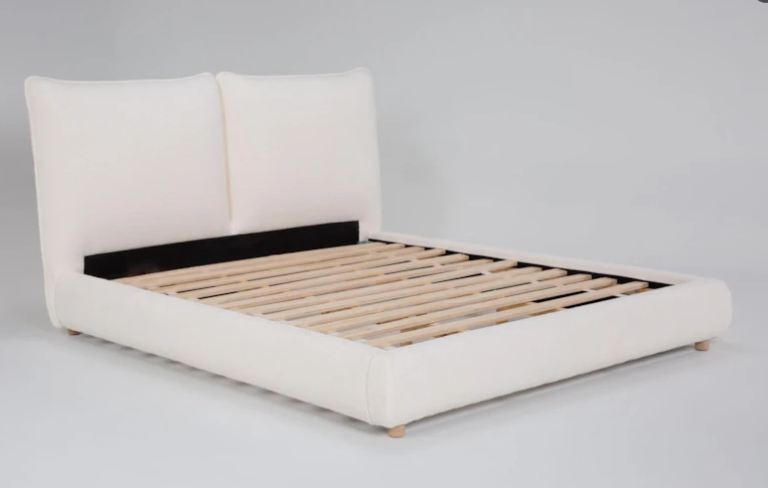
Curved Double-Cushion Gas Lift Storage Bed
A curved upholstered headboard with a gas-lift storage base for retail and import programmes. The reference model uses 14 rows of straight wood slats…
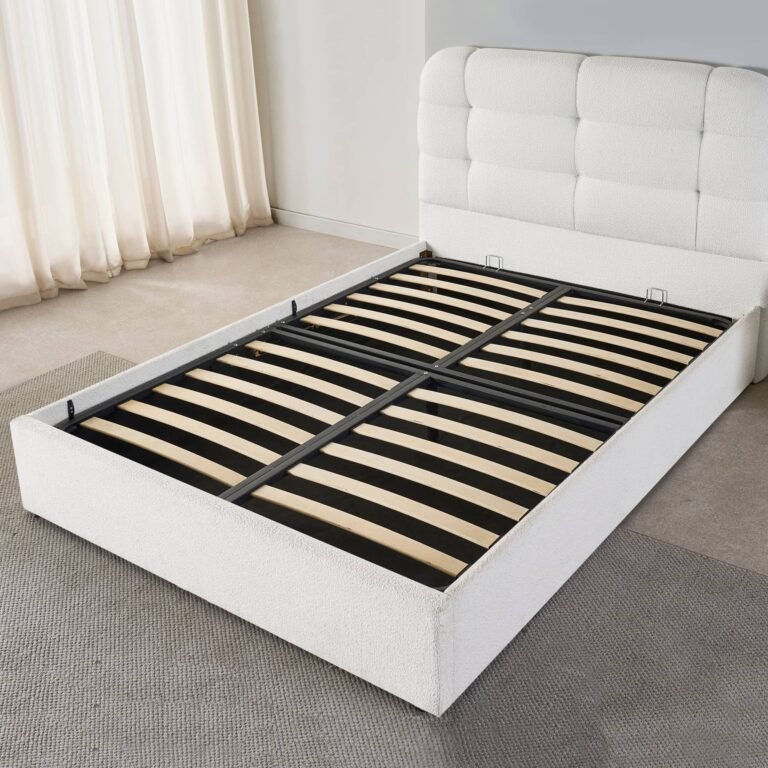
Rounded-Channel Gas Lift Storage Bed
A rounded-channel upholstered headboard paired with a folding gas-lift storage base for retail and import programmes. The reference build uses 12 rows of curved…
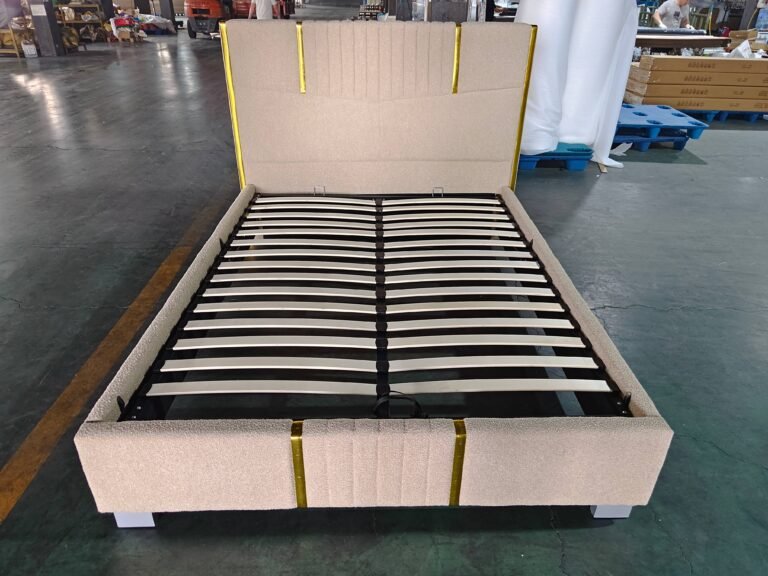
Gold-Accent Channel Gas Lift Storage Bed
A gas-lift storage bed with a channelled 130 cm headboard and 50 mm electroplated legs for decorative retail ranges. The reference build uses 15…
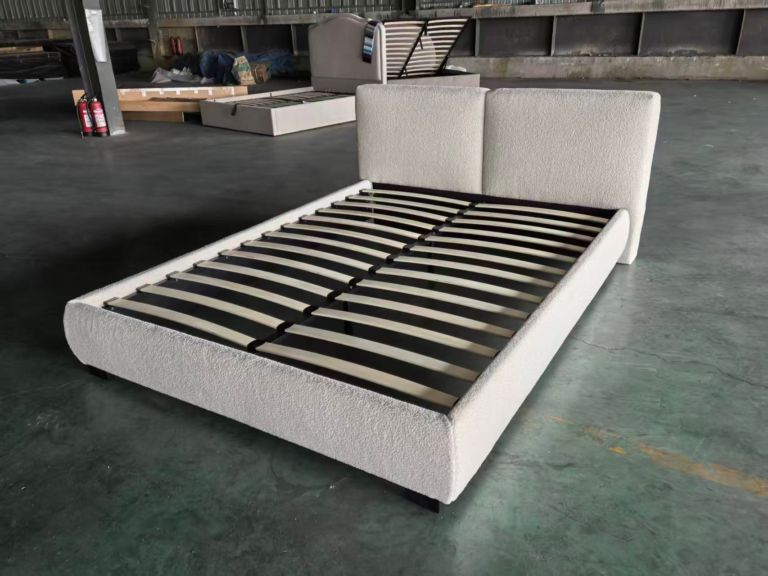
Twin-Cushion Gas Lift Storage Bed
A gas-lift storage bed with an 85 cm twin-cushion headboard, curved side rails and a curved footboard. The reference build uses 13 rows of…
Questions buyers usually ask
These are the practical points worth confirming with the supplier before you approve a sample or a production order.
Are gas-lift beds easier to assemble than drawer beds?
They can be, depending on the design. In our experience, drawer systems often involve more separate parts and fixing steps. Our simplified gas-lift design uses approximately 25 screws and around two or three screw types, with an instruction manual and assembly video. Always compare the actual hardware list and instructions for the models you are considering.
Can a gas-lift bed open from the side or from the foot end?
Selected models can be designed with different opening directions. The available arrangement depends on the frame and mechanism. Confirm the exact model, opening direction, room layout and mattress compatibility before ordering.
Why does one bed use one carton while another uses two or three?
Split side rails and a folding base can make a more compact pack. Full-length side rails or a base that cannot be folded or separated may need their own carton. The actual carton count must be confirmed from the model's packing plan.
Which structure should I choose for online retail?
Start with carton dimensions, parcel limits, assembly steps and the delivery method. A compact one-carton design with clear instructions may suit parcel-led sales, but the finished appearance and product positioning also matter. Compare the actual model rather than choosing by structure name alone.
What information should I request before approving a bed frame?
Ask for the model-specific structure, material and slat details, gas-lift specification where applicable, assembly instructions, hardware list, carton count, each carton’s dimensions and gross weight, CBM and container loading estimate. Also identify any destination-market testing or documentation required for your programme.
Tell us how you plan to sell the bed.
Share your destination market, sales channel, target size, preferred storage or base structure and estimated order quantity. If you have a reference model, drawing or packing target, send that too. We will review the suitable existing models and confirm the available configuration, packing details, MOQ, lead time and quotation against the requirements.
Destination country · Online or physical retail · Bed size · Gas-lift / non-storage / drawer preference · Side rail format · One- or multi-carton target · Required carton limits · Estimated quantity or container plan.