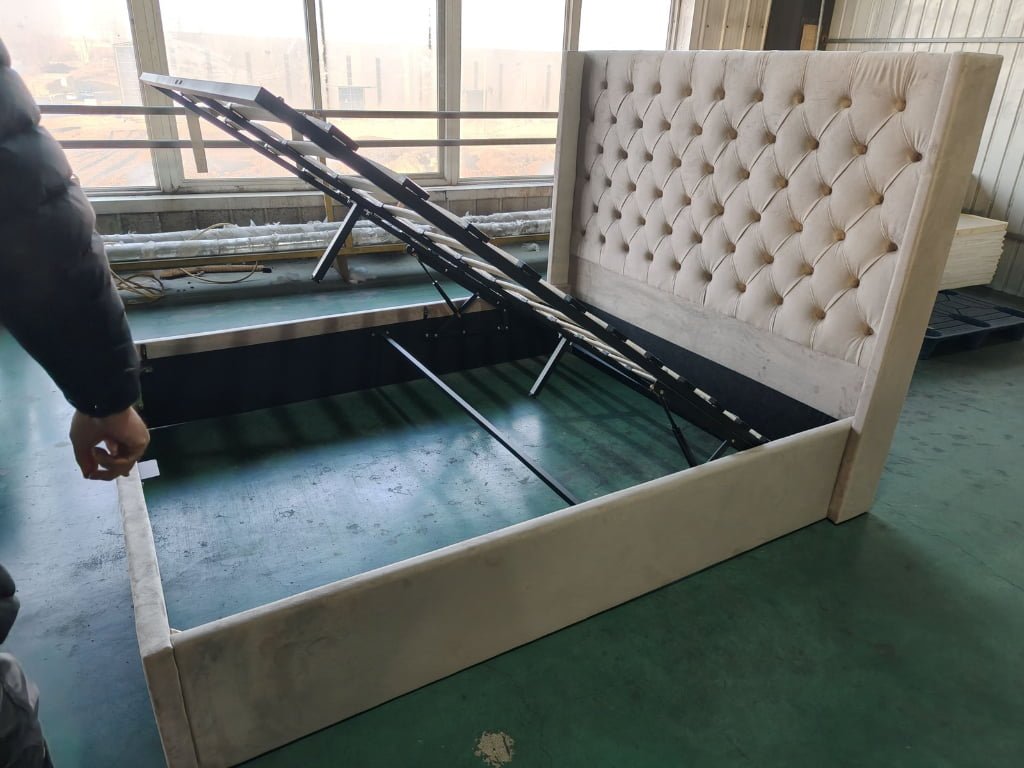
How to verify the quality of beds imported from China?
Beds imported from China can look excellent in a showroom sample but arrive with inconsistent holes, weak connections, missing hardware, or damaged upholstery. These problems increase assembly failures, returns, and replacement costs. I reduce that risk by defining measurable requirements, inspecting production units, testing assembly, and verifying packaging before shipment approval.
To verify bed quality, I first approve a reference sample and a detailed specification. I then inspect randomly selected production units for dimensions, hole alignment, structural stability, materials, upholstery, hardware, finish, assembly, and packaging. I treat certificates and supplier photos as supporting evidence, not as substitutes for shipment sampling or required laboratory testing.
I regard bed inspection as a staged risk-control process rather than a final visual check. The following sections explain how I set quality requirements, choose samples, inspect upholstered and metal beds, and decide whether finished cartons are ready for retail distribution.
How should I define the quality of beds imported from China before production?
An unclear purchase order creates avoidable disputes. A buyer may expect stronger slats, denser fabric, or heavier hardware, while the factory may manufacture according to its usual commercial grade. If neither side records the details, a visually acceptable bed can still fail the buyer’s market requirements.
I define bed quality through an approved sample, technical specifications, measurable tolerances, material descriptions, hardware requirements, packaging instructions, and defect criteria. I also identify which features require physical testing. This approach gives the buyer, supplier, and inspector the same reference instead of relying on terms such as “good quality” or “export standard.”
Build a model-specific specification
I never assume that one specification applies equally to an upholstered bed, a metal bed, and a mattress. This article focuses on bed frames and upholstered beds, not mattress construction or mattress performance.
For each model, I recommend recording:
- Overall length, width, and height
- Mattress opening dimensions
- Headboard and footboard dimensions
- Ground clearance
- Slat dimensions, quantity, spacing, and material
- Side-rail and center-support construction
- Board type and specified thickness
- Metal tube dimensions and wall thickness, where applicable
- Upholstery fabric type, color, density, and approved swatch
- Stitching position and appearance
- Foam location and agreed characteristics
- Hydraulic storage-lift configuration, if applicable
- Fastener type, size, finish, and quantity
- Assembly-hole location and tolerance
- Carton dimensions, markings, and target gross weight
- Required labels, instructions, and hardware kits
The approved sample should represent these written requirements. However, I do not treat that sample as evidence that every production unit will be identical.
An approved sample establishes the target. It does not prove batch consistency.
Separate measurable requirements from subjective descriptions
I have seen disagreements begin with words such as “soft,” “strong,” “premium,” and “stable.” These terms can support a design discussion, but they are weak inspection criteria.
I prefer measurable or directly comparable requirements. For example, a purchase order can specify a fabric code and approved color swatch instead of “high-quality grey fabric.” It can state the slat dimensions and minimum quantity instead of “strong wooden slats.”
A bed’s wooden frame may use several materials:
| Frame material | Procurement consideration | Inspection focus |
|---|---|---|
| Plywood | Layers and grade can vary | Thickness, voids, delamination, edge condition |
| Particleboard | Economical but sensitive to fastener design and moisture | Density consistency, edge damage, screw holding areas |
| MDF | Smooth and dimensionally consistent for some parts | Thickness, moisture damage, edge integrity |
| Solid wood | Species and moisture condition affect performance | Knots, cracks, warping, joints, species confirmation |
I do not claim that one material is always superior. The correct choice depends on the design, connection method, price level, expected use, and destination market.
Agree on defect classifications
I also recommend agreeing on critical, major, and minor defects before inspection.
- A critical defect can create an unacceptable safety or regulatory risk.
- A major defect can prevent assembly, normal use, or sale at the intended grade.
- A minor defect affects appearance or workmanship without seriously affecting normal use.
The parties should define model-specific examples and an agreed sampling plan. A qualified inspection company can help select an appropriate plan. Required structural, chemical, flammability, or market-compliance tests should be handled by qualified laboratories or professionals.
How should I sample beds imported from China during inspection?
Supplier-selected photos show only what the supplier chooses to photograph. A single perfect bed also says little about a shipment containing hundreds of cartons. I have found alignment and hardware issues in production units even when the approved sample looked correct.
I use random sampling across different cartons, pallet positions, production dates, colors, and sizes. I check complete units rather than isolated components whenever possible. The inspection should combine visual examination, dimensional checks, assembly trials, component counts, and packaging review under an agreed sampling and defect-classification plan.
Select cartons across the shipment
I do not ask the factory to place several “inspection samples” in a separate area without verifying where they came from. Instead, I prefer samples selected from the available finished shipment.
My selection normally considers:
- Different bed sizes
- Different colors or fabrics
- Different carton locations
- Different production batches, if identifiable
- Different packing dates
- Each model included in the order
- Beds with and without storage mechanisms
The appropriate sample size depends on the order quantity, inspection level, buyer’s risk tolerance, and agreed acceptance criteria. I avoid inventing a universal sample size because no single number fits every shipment.
Conduct a full assembly trial
An assembly trial often reveals defects that remain invisible inside a closed carton. I have encountered beds where the side rails looked normal, but the holes did not align with the headboard. I have also seen a longitudinal support or footboard leave production without a required hole.
During an assembly check, I look for:
- Missing or incorrectly positioned holes
- Holes that are too small or obstructed by upholstery
- Batch-to-batch changes in hole position
- Incorrect left and right components
- Fasteners that cannot engage fully
- Missing washers, nuts, screws, or brackets
- Components that require forced alignment
- Gaps or twisting after tightening
- An unstable or frequently moving headboard
- Noise when the frame is pushed, loaded, or moved
- Instructions that do not match the supplied parts
A pull strap secured with one screw, for example, may conflict with an approved two-screw design. The difference can appear minor in a component photograph, but it can indicate poor process control or nonconformance with the order.
Verify dimensions and repeatability
I measure more than the outer dimensions. I compare the mattress opening, side-rail height, support position, hole spacing, and component symmetry with the specification.
I also compare measurements among sampled units. One correctly sized bed does not resolve a consistency problem if other units vary outside the agreed tolerance.
| Check | Why it matters | Possible commercial consequence |
|---|---|---|
| Mattress opening | Determines mattress fit | Complaints, gaps, or inability to install |
| Hole spacing | Controls assembly | Failed installation and returns |
| Side-rail length | Affects frame geometry | Twisting or visible gaps |
| Headboard connection | Controls stability | Wobbling during use |
| Slat spacing | Affects support arrangement | Uneven support or specification failure |
| Leg height | Controls level and clearance | Rocking or inconsistent appearance |
I record actual measurements rather than writing only “pass.” Photos should show the measuring tool, component, and reading clearly.
Which materials and structural details determine bed quality?
Attractive upholstery can hide weak supports, thin slats, poorly anchored fittings, or unstable joints. These defects may not appear during a short showroom presentation. They can emerge during customer assembly, movement, or repeated use.
I evaluate bed quality by checking the complete load path: headboard connections, side rails, center supports, legs, slats, brackets, fasteners, and storage-lift hardware. I then compare each material and component with the approved specification. I refer application-specific load or safety questions to qualified engineering or laboratory professionals.
Check slats, supports, and joints
In our production experience, one available configuration has used at least 26 wooden slats measuring about 55 × 10 mm. The original factory shorthand may describe this as “55 × 1 cm.” However, I treat this only as a product configuration, not as a universal minimum for every bed.
Different designs may require thicker slats, different spacing, additional center supports, or different wood species. I therefore verify:
- Slat width and thickness
- Total slat count
- Slat spacing
- Visible cracks, knots, or warping
- End-cap fit, if used
- Center-rail dimensions
- Number and position of support legs
- Connection quality at load-bearing points
I pay special attention to the headboard. If the factory uses too little fixing material or weak connection points, the headboard can move whenever the frame is shifted. I assemble the bed, tighten it according to the instructions, and check whether movement remains excessive.
Evaluate storage-lift hardware carefully
Beds with hydraulic storage systems need additional controls. I check whether the left and right gas struts match the approved configuration and whether their markings are consistent with the order.
I have seen inspection concerns involving mismatched struts, including left and right components marked with different force values. A marking such as 80 kg or 60 kg should never be accepted automatically. The buyer must confirm that the mechanism, force rating, mounting geometry, and bed design match the approved engineering requirements.
My visual and functional checks include:
- Left and right strut identification
- Part-number and marking consistency
- Bracket position
- Fastener engagement
- Smooth opening and closing
- Frame interference
- Uneven lifting
- Pull-strap attachment
- Mattress-retaining components
- Warning labels and instructions, if specified
A visual operation check does not replace engineering validation, cycle testing, or required safety testing.
Use carton weight as a consistency indicator
Gross weight can help identify missing or substituted components. It cannot prove quality by itself, but an unusual difference between the approved packing standard and the actual carton deserves investigation.
Our past reference weights for certain upholstered-bed configurations have been approximately:
| Configuration | Single | Double | Queen | King |
|---|---|---|---|---|
| No storage function | 22 kg | 28 kg | 31 kg | 34 kg |
| Hydraulic storage lift | 34 kg | 40 kg | 43 kg | 46 kg |
| Drawer storage | 40 kg | 50 kg | 53 kg | 56 kg |
I use these figures only as historical model references. Actual weights vary with dimensions, boards, metal thickness, upholstery, hardware, packaging, and accessories. Buyers should establish approved net and gross weights for each SKU rather than apply this table to unrelated models.
How should I inspect upholstered beds imported from China?
Upholstery can make two structurally similar beds look completely different. It can also conceal board damage, uneven foam, misplaced holes, and weak workmanship. If color, hand feel, or stitching changes during mass production, retailers can receive a product that no longer matches their listing or display sample.
I inspect upholstery against an approved swatch and sample. I check fabric identity, color, texture, density, cutting direction, tension, seams, corners, backing, and concealed surfaces. I also inspect through or around the upholstery to confirm that assembly holes and structural components remain accessible and correctly positioned.
Compare fabrics by specification, not name alone
Common upholstered-bed materials include:
- PU-coated upholstery
- PVC-coated upholstery
- Velvet
- Linen-look fabric
- Corduroy
- Sherpa or bouclé-style fabric
- Chenille
From our 2026 commercial observations, corduroy, chenille, and sherpa-style fabrics have been popular for younger-market designs[^1]. Velvet and linen-look fabrics remain common on established models. However, I would confirm current demand in the buyer’s own market before making a purchasing decision.
A fabric name does not establish its grade. Two velvets can have different density, backing, pile, hand feel, durability, and color appearance. I have seen a design look more substantial in sherpa-style fabric while the same shape looked sharper in velvet. Neither result makes one fabric universally better.
Our past local sourcing observations have included wide price ranges. Some sherpa-style fabrics were quoted around RMB 13, RMB 18, or RMB 28 per meter. Velvet options ranged from roughly RMB 8 to RMB 18 per meter in some cases. These figures are indicative anecdotes, not current market quotations. Width, composition, backing, order volume, supplier, and finish can change the cost.
I therefore ask for:
- Supplier fabric code
- Composition declaration
- Usable width
- Color code and approved swatch
- Weight or density information where applicable
- Backing type
- Performance reports required by the destination market
- Lot-control method
- Replacement-lot approval procedure
Inspect upholstery workmanship
I inspect both visible and concealed areas. My checklist includes:
- Color variation between panels
- Pile direction inconsistency
- Wrinkles or excessive tension
- Uneven foam appearance
- Crooked stitching
- Loose threads
- Open seams
- Uneven piping
- Exposed staples
- Sharp hardware under the fabric
- Abrasion on the headboard backing
- Fabric covering assembly holes
- Small heat-cut holes that block installation
- Stains, glue marks, and handling damage
The underside of many upholstered beds uses non-woven fabric. Some higher-priced configurations use MDF bottom panels, which may add roughly US$15 in certain historical quotations. I verify the exact order because the price and quality effect depend on the panel thickness, design, and intended function.
I also distinguish a cosmetic backing defect from a structural problem. Slightly abraded non-woven fabric may be classified differently from torn upholstery on a retail-visible surface. The agreed defect criteria should make that distinction clear.
How should I inspect metal beds, finishes, and hardware?
Metal beds often fail inspection for reasons that appear small in photographs. A paint scratch, weld spatter, dent, internal rust, or weak support bar can affect appearance, assembly, and long-term performance. Mixed or excess plastic parts can also indicate uncontrolled packing.
I inspect metal beds for tube dimensions, specified wall thickness, weld quality, straightness, support design, coating coverage, scratches, dents, rust, and contamination. I also conduct an assembly trial and count all fittings. Structural performance and coating compliance should be verified through qualified testing when the market or buyer requires it.
Inspect welding and metal preparation
I look closely at load-bearing joints, brackets, legs, and support bars. Common findings can include:
- Weld spatter on bed legs
- Incomplete or uneven welds
- Sharp edges or burrs
- Distorted brackets
- Thin or incorrect support rods
- Misaligned welded nuts
- Tube ends without proper protection
- Residue inside steel tubes
- Rust or dirt inside black-painted bunk-bed tubing
A thicker support bar may reduce certain failure risks, but thickness alone does not prove adequate strength. Material grade, span, joint design, wall thickness, load distribution, and welding quality also matter. I recommend engineering review or applicable performance testing when structural capacity is critical.
Examine coating and appearance under good light
I rotate parts and inspect them under consistent lighting. Common finish defects include:
- Scratches
- Slight dents
- Chipped coating
- Poor paint coverage
- Color inconsistency
- Orange peel or rough texture
- Contamination under the coating
- Rust at holes or tube ends
I classify the defect according to location, size, visibility, and agreed acceptance criteria. A small mark on a hidden internal surface may not have the same commercial effect as a scratch on a visible headboard rail.
Count and identify every hardware component
A bed that cannot be assembled is not retail-ready, even if every major frame component looks good. I count screws, bolts, washers, nuts, brackets, plastic caps, feet, and tools against the bill of materials and instruction manual.
I have seen kits with one or two more plastic sleeves than the standard. Extra low-value parts may seem harmless, but unexplained quantity changes can confuse consumers or signal that packing controls are weak. Missing hardware presents a more immediate return risk.
I prefer a sealed and labeled hardware bag with:
- A component list
- Part codes
- Quantities
- Model identification
- Clear assembly-stage references
- Spare parts only when the specification intentionally requires them
I also compare the instructions with the actual bed. A correct hardware kit still causes problems when diagrams show an old bracket or a discontinued connection method.
How do I verify that beds imported from China are ready for shipment?
A bed can pass factory workmanship checks and still arrive unsellable. Weak cartons, poor moisture precautions, missing labels, mixed components, or incorrect instructions can turn acceptable products into customer returns. Final inspection must therefore cover retail and logistics readiness, not only the bed itself.
I verify carton strength and condition, internal protection, moisture precautions, hardware containment, component counts, instructions, labels, barcodes, shipping marks, and carton identification. I also compare actual weights and dimensions with approved packing data. Shipment approval should remain conditional on resolving major nonconformities and verifying required documents.
Check internal and external protection
I open sampled cartons and examine how parts are separated. I look for contact points that can cause abrasion during handling and transport.
My packaging checks include:
- Carton condition and specified construction
- Corner and edge protection
- Separation between metal parts
- Protection for upholstered surfaces
- Bags or sleeves around painted components
- Secure hardware placement
- Moisture precautions appropriate to the route
- Protection against staples contacting fabric
- Correct component orientation
- Carton closure and strapping
- Palletization, if specified
The buyer and supplier should agree on packaging before production. I avoid assuming that a generic “export carton” will withstand a particular distribution network.
Verify labeling and carton identity
I compare every sampled carton with the purchase order and approved artwork. I check:
- SKU and model number
- Bed size
- Color or fabric code
- Carton number, such as 1 of 2 and 2 of 2
- Quantity
- Gross and net weight
- Carton dimensions
- Country-of-origin marking
- Barcode readability
- Handling symbols
- Customer-specific labels
- Shipping marks
Multi-carton products require special attention. If carton 1 contains one color and carton 2 contains another, the warehouse may assemble a mixed bed even though each carton is individually complete.
Treat documents as supporting evidence
I review test reports and certificates, but I do not treat a document as proof that the shipment is defect-free or legally compliant.
I verify whether each document matches:
- The actual model
- Relevant construction and materials
- Fabric or coating
- Production location, where relevant
- Test method and report scope
- Destination-market requirement
- Validity or issue date
- Applicant and manufacturer details
Any market-specific claim involving flammability, chemical restrictions, structural performance, bunk-bed safety, labeling, or other regulated matters requires independent confirmation. A qualified laboratory, engineer, compliance consultant, or legal professional should evaluate the applicable requirements.
Frequently Asked Questions
Is one approved sample enough to verify bed quality?
No. I use the approved sample as a production reference, but I also inspect randomly selected shipment units. Batch production can introduce material substitutions, dimensional variation, missing holes, finish defects, or packing errors that do not appear in the original sample.
Should I inspect every imported bed?
A 100% inspection may be appropriate for some high-risk orders, but it is not always commercially practical. I normally use an agreed statistical sampling plan based on order size and risk. I recommend professional advice when selecting inspection levels and acceptance criteria.
Can carton weight reveal missing bed components?
Carton weight can highlight an abnormal difference, but it cannot identify the cause by itself. I compare actual weight with an approved model-specific range and then open suspicious cartons. Packaging variation, moisture, substituted boards, missing hardware, or incorrect components can all affect weight.
Are supplier photos sufficient for pre-shipment approval?
No. Supplier photos can support communication, but they do not demonstrate random sampling or shipment-wide consistency. I prefer an inspection that records carton selection, measurements, assembly results, defects, component counts, and packaging findings.
How do I verify a bed test report or certificate?
I compare the document with the actual model, materials, construction, factory, test scope, and destination-market requirements. I also confirm the report with the issuing body when possible. I ask a qualified compliance professional to assess whether the evidence is sufficient for the intended market.
Conclusion
Verifying the quality of beds imported from China requires controls before, during, and after production. I start with an approved sample and measurable specifications. I then sample finished units, assemble complete beds, inspect structures and upholstery, count hardware, and verify packaging. I treat certificates as model-specific supporting evidence and refer technical compliance questions to qualified professionals. Before approving your next shipment, ask your supplier or inspection partner for a written, model-specific QC plan that covers production consistency, assembly, packaging, and retail readiness.